
A “granny summary” of the article by Dror Dotan, Guy Almani, and Meital Norman
The development of number reading:
Fifth-grade children show adult-like visual analysis of digit strings
One of our previous studies (which I wrote about here) showed that third graders—and even fourth graders—still struggle to read multi-digit numbers and make many errors. This was a bit surprising. As adults, we tend to think of reading numbers as something simple and effortless, requiring almost no thought. Our study showed that this is not really the case.
In the study I’m going to tell you about now, we found an opposite surprise. We tested fifth graders, just one year older than the children in the previous study, and found that they read numbers extremely well – even better than adults!
So what happened? Did children suddenly make a huge leap in just one year?
Or are we missing something?
What we were missing is that reading numbers is actually a complex cognitive task. True, it is relatively easy to perform, at least for adults, but it still relies on many different mechanisms in the brain (I wrote more about that here). Like for many other automatic skills: for example, most of us walk effortlessly, yet walking is an extremely complex cognitive task.
Reading numbers too relies on multiple mechanisms. Some are visual: they process the sequence of digits. Others are verbal: they generate the corresponding sequence of number words. Our previous study, with third- and fourth-grade children, focused mainly on verbal processing, whereas the present study focused on visual processing. So the apparent discrepancy between the two studies may be, at least in part, due to the fact that they examined different cognitive mechanisms.
So let’s dive into what we did in the present study.
How did we avoid focusing on verbal processing?
Our previous study (and several others) showed that certain numbers are particularly difficult to read because they have irregular verbal structures. For example, numbers containing 0 are verbally irregular because, unlike the other digits, zero is not pronounced. So here, we did not use the digit 0.
Once we restricted the list of numbers this way, fifth graders read the numbers as well as adults. So yes, it is possible that children make an important developmental leap between fourth and fifth grade. But it is also possible that some of the difficulty we observed previously originated in the irregular numbers, and once those are removed, children can read quite well.
As I mentioned earlier, the children actually outperformed the adults – they made fewer errors. How could that be? One possible explanation is that our experiment used four- and five-digit numbers without zeros—e.g., 49,238—and elementary-school children are more practiced at reading such numbers, because they encounter them all the time. Try to think: when was the last time you had to read aloud such a number?
How did we focus on visual processing?
To do that, we looked not only at how many errors the children made, but also at how they read the numbers. It was the idea of Guy and Meital – two master’s students in our program for learning disorders, who took a seminar course I gave. In the course we learned that, in adults, the visual mechanisms that process digit strings “scan” the digits from left to right (see the study here). Guy and Meital pointed out—quite rightly—that it is far from obvious that Hebrew-speaking children would do the same. Hebrew text is read from right to left, so children’s visual system might initially struggle with the discrepancy between the reading directions of words (right-to-left) and numbers (left-to-right). They also argued, again quite rightly, that some empirical hints support this intuition: young Hebrew-speaking children often confuse the order of digits – e.g., they may read 23 as “thirty-two” (my own daughter made errors like this when she was young). This might be related to the directionality of their visual processing.
To test the scanning direction, we adopted a trick we had previously used with adults (in this study). We presented each number briefly, just one tenth of a second, and the children read it aloud. In such a short time, the visual system cannot fully process all the digits. Digits processed relatively early are more likely to be processed successfully, before the number disappears, than digits processed later. Therefore, if the visual system scans numbers from left to right, the leftmost digits should be identified more accurately, and accuracy should gradually decrease for digits farther to the right.
Figure 1 shows precisely this pattern in the children (ignore the two outer digits – they are always easier to identify because each has only one neighboring digit rather than two).
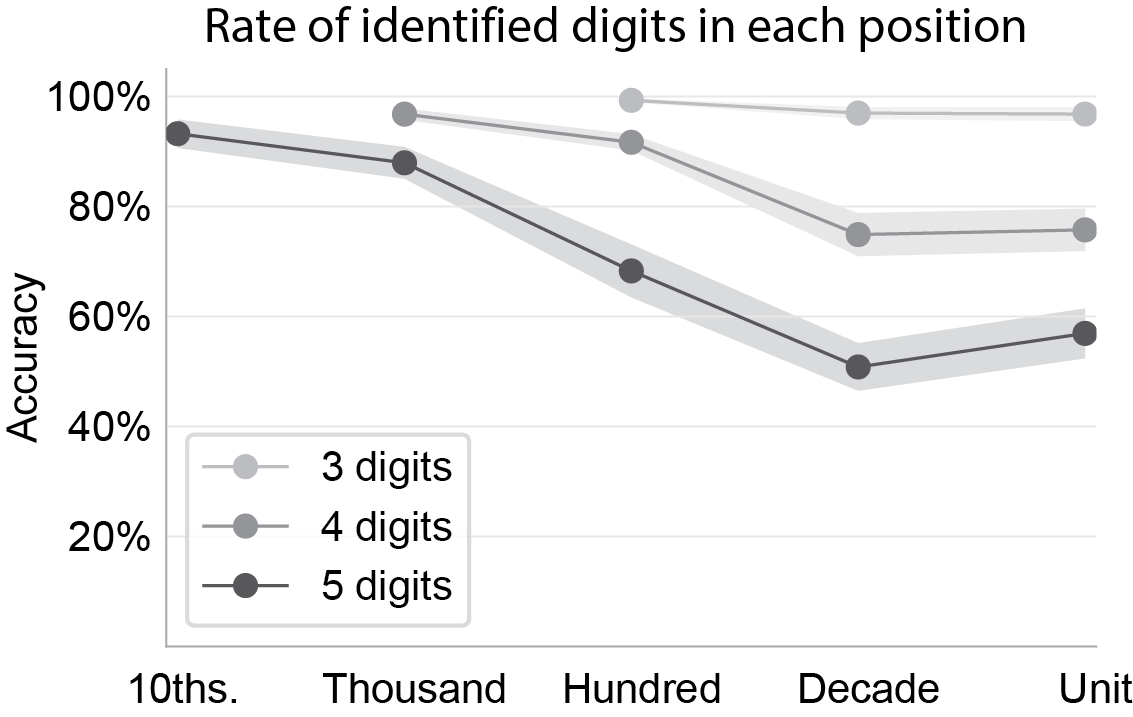
Figure 1. Percentage of digits correctly identified at each decimal position. Digits on the left were identified more accurately because they were processed earlier, giving participants enough time to process them despite the brief presentation. Digits farther to the right, which are processed later, were not identified as well.
These findings indicate that, by the fifth grade, children’s visual processing of digit strings is serial and proceeds from left to right – just like in adults. In other words, fifth graders not only read numbers as well as adults, but they also show adult-like characteristics of the underlying visual processing mechanisms.
So what did we learn?
This study shows that important parts of children’s visual processing system are already functioning in an adult-like way by fifth grade. Exactly when these mechanisms develop, we do not know, because we did not examine younger children systematically. However, as mentioned earlier, young Hebrew-speaking children sometimes read numbers in reverse order, and this may reflect an immature visual processing system.
Does visual processing mature earlier than verbal processing? Is that the real explanation for the apparent “jump” between fourth and fifth grade? We still can’t be sure about that. To answer the question, we would need to run exactly the same experiment with both fourth and fifth graders. So far, we have not done that.
To me, perhaps the most interesting lesson from the study is that there is no single answer to the question “When do children learn to read numbers?” Reading numbers is not one ability but a collection of multiple cognitive sub-skills, driven by different cognitive processes that may mature at different rates. In fact, the same is true of many other complex abilities. Think about playing the piano: it requires reading music, finger coordination, rhythm, and musical expression. Or think about cooking, driving, and many other human activities. All of these are complex abilities, and for all of them, asking “When do you learn to do it?” is not a difficult question – it is a meaningless question, because it does not acknowledge the activity’s complexity.
Interesting? The full article is here.